| Paradigm | Name | Description |
 | Ascot cap | A hard style of hat, usually worn by men, dating back to the 1900s. Sometimes associated with livestock slaughter. |
 | Akubra | An Australian brand of bush hat, whose wide-brimmed styles are a distinctive part of Australian culture, specially in rural areas |
 | Ayam | A traditional Korean winter cap mostly worn by women in the Joseon and Daehan Jeguk periods (1392–1910). |
 | Balaclava | Headgear, commonly made from fabric such as cotton and/or polyester, that covers the whole head, exposing simply the face or function of it. Sometimes only the optics or eyes and mouth are visible. Also known as a ski mask. |
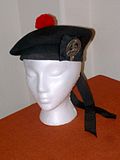 | Balmoral bonnet | Traditional Scottish bonnet or cap worn with Scottish Highland dress. |
 | Barretina | A floppy fabric pull-on hat, usually worn with its elevation flopped downwardly. In red, it is at present used as a symbol of Catalan identity. |
 | Baseball cap | A type of soft, light cotton cap with a rounded crown and a strong, forrad-projecting bill. |
 | Beanie | A brimless cap, with or without a small visor, once popular among schoolboys. Sometimes includes a propeller.
Note: In New Zealand, Australia, the Great britain, and parts of the Usa, "beanie" too or otherwise refers to the knit cap or tuque used during winter to provide warmth. |
 | Bearskin | The tall, furry hat of the Brigade of Guards' full-dress uniform, originally designed to protect them against sword-cuts, etc. Commonly seen at Buckingham Palace in London, England. Sometimes mistakenly identified equally a busby. |
 | Beret | A soft round cap, usually of woollen felt, with a bulging flat crown and tight-plumbing equipment brimless headband. Worn past both men and women and traditionally associated with France, Basque people, and the military. Often part of [European?] schoolgirls' compatible during the 1920s, '30s and '40s. |
 | Bhaad-gaaule topi | A typical Nepali cap |
 | Bicorne | A broad-brimmed felt hat with skirt folded up and pinned front and back to create a long-horned shape. Besides known as a cocked hat. Worn by European military officers in the 1790s and, as illustrated, commonly associated with Napoleon. |
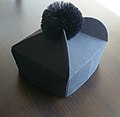 | Biretta | A square cap with three or twelve ridges or peaks worn past Roman Cosmic (and some Anglican and Lutheran) clergy. |
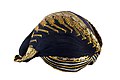 | Blangkon | A traditional Javanese man'due south hat. |
 | Boater | A flat-brimmed and flat-topped straw hat formerly worn by seamen. Schools, particularly public schools in the UK, might include a boater equally part of their (summer) uniform. At present mostly worn at summer regattas or formal garden parties, frequently with a ribbon in club, higher or schoolhouse colors. |
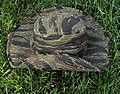 | Boonie hat | A soft, wide-brimmed cotton lid commonly used by military forces. As well known every bit a bush-league hat and similar to a bucket lid. |
 | Boss of the Plains | A lightweight all-conditions hat, with a high rounded crown and wide flat brim, designed by John B. Stetson for the demands of the American frontier. |
 | Boudoir cap | A type of decorative cap mainly worn in the 19th and early 20th century with sleepwear or lingerie. |
 | Bowler / Derby | A hard felt hat with a rounded crown created in 1850 past Lock's of St James's, the hatters to Thomas Coke, 2nd Earl of Leicester, for his servants. More ordinarily known as a Derby in the U.s.. |
 | Breton | A woman's hat with circular crown and deep skirt turned up all the way round. Said to exist based on hats worn by Breton agricultural workers. |
 | Bucket hat | A soft cotton wool hat with a wide, downwards-sloping brim. |
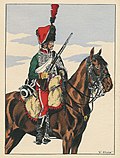 | Busby | A small fur military machine hat. |
 | Bycocket | "Robin Hood's hat", a wide brimmed hat that is turned up in the dorsum and pointed in the front end like a bird's beak. |
 | Campaign chapeau | Also known as a "Smokey Behave" hat. A broad-brimmed felt or straw hat with high crown, pinched symmetrically at its four corners (the "Montana crease"). |
 | Capirote | A conical pointed hat with eye holes. Historically associated with the Ku Klux Klan in the United states of america of America, but still used elsewhere in other contexts (such as the example illustrated, featuring people from Nazareno processing during Holy Week in Spain). |
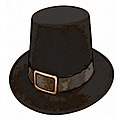 | Capotain | A lid worn between the 1590s and 1640s in England and northwestern Europe. Also known as a "Pilgrim hat" in the United states. |
 | Cappello romano | A round wide-brimmed hat worn past more traditional Roman Catholic clergy. |
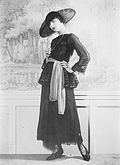 | Cartwheel hat | Wide-brimmed and shallow-crowned hat, normally worn at an bending. Popular from 1910s but most closely associated with 1940s-50s mode. |
 | Casquette | A small-peaked cap often worn by cyclists. |
 | Caubeen | An Irish beret.[one] |
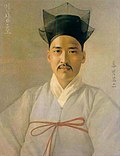 | Chengziguan | A traditional horse pilus hat dating back to 10th century Red china, which afterwards became popular amid the yangban of Joseon Dynasty Korea as an alternative to the gat. |
 | Chilote cap | A woven cap, typical of Chiloé Archipelago, that is made of coarse raw wool and ordinarily topped past a pom-pom. |
 | Chullo | Peruvian or Bolivian hat with ear-flaps made from vicuña, alpaca, llama or sheep's wool.[2] |
 | Chupalla | A straw hat fabricated in Chile. |
 | Cloche hat | A bell-shaped ladies' hat that was popular during the Roaring Twenties. |
 | Cricket cap | A type of soft cap traditionally worn by cricket players. |
 | Sombrero Cordobés | A traditional apartment-brimmed and flat-topped hat originating from Córdoba, Kingdom of spain, associated with flamenco dancing and music and popularized by characters such equally Zorro. |
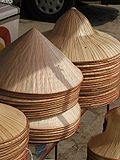 | Conical Asian hat | A conical straw hat associated with East and Southeast Asia. Sometimes known as a "coolie hat", although the term "coolie" may be interpreted every bit derogatory.[3] [four] |
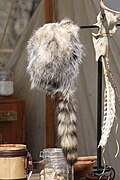 | Coonskin cap | A hat, fashioned from the pare and fur of a raccoon, that became associated with Canadian and American frontiersmen of the 18th and 19th centuries. |
 | Custodian helmet | A helmet traditionally worn by British police constables while on foot patrol. |
 | Deerstalker | A warm, close-fitting tweed cap, with brims front and backside and ear-flaps that tin can be tied together either over the crown or under the chin. Originally designed for use while hunting in the climate of Scotland. Worn by – and so closely associated with – the graphic symbol Sherlock Holmes. |
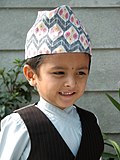 | Dhaka topi | A typical Nepali cap made up of fabric called dhaka |
 | Dixie cup hat | Besides known as "gob chapeau" or "gob cap." A sailor cap worn in several navies, of white canvas with an upright brim. |
 | Draped turban | A fashion dating back to at least the 18th century, in which fabric is draped or moulded to the head, concealing most or all of the hair. Original designs were said to exist inspired by the turbans of India and the Ottoman Empire |
 | Dunce cap | A conical lid, usually tall and narrow, worn by tardily-19th and early-20th century school pupils as a punishment and/or humiliation. Information technology oft featured a big majuscule "D" inscribed on its side, to be shown frontwards when the chapeau was worn. |
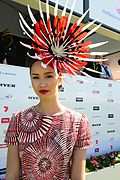 | Fascinator | A pocket-size hat unremarkably made with feathers, flowers and/or beads.[five] Information technology attaches to the pilus by a comb, headband or clip. |
 | Fedora | A soft felt lid with a medium brim and lengthwise crease in the crown. |
 | Fez | Red felt hat in the shape of a truncated cone, mutual to Arab-speaking countries. |
 | Flat cap | A soft, round wool or tweed men's cap with a small bill in front end. |
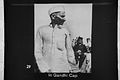 | Gandhi cap | Typical cotton white cap named subsequently Mahatma Gandhi 'begetter of nation' of Bharat. Mostly worn past Indian politicians and people. |
 | Gat | A traditional Korean hat worn by men. |
 | Gatsby | A soft brimmed hat popular in New York afterward the plough of the century made from eight quarter panels. Also known as a newsboy cap. |
 | Garrison or Fodder cap | A foldable textile cap with directly sides and a creased or hollow crown. |
 | Gaung Paung | Headwrap worn by the Bamar, Mon people, Rakhine and Shan peoples. |
 | Glengarry | A traditional Scottish gunkhole-shaped chapeau without a height made of thick-milled woollen fabric with a toorie on summit, a rosette cockade on the left, and (usually) ribbons hanging down behind. It is usually worn as part of Scottish military or civilian Highland dress. |
 | Green eyeshade | Once common-habiliment for office clerks. |
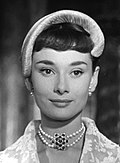 | Half chapeau | Millinery blueprint that covers only half the caput – particularly pop in the 1950s. |
 | Halo chapeau | Semi-circular or circular design that frames the face, creating a 'halo' or 'aureole' consequence. |
 | Hard hat | A rounded rigid helmet with a small skirt predominantly used in workplace environments, such as structure sites, to protect the head from injury by falling objects, debris and bad weather. |
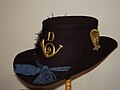 | Hardee hat | Also known as the 1858 Wearing apparel Hat. Regulation lid for Union soldiers during the American Ceremonious War. |
 | Hennin | A woman'due south hat of the Middle Ages.[6] This mode includes the conical "princess" hats often seen in illustrations of folk-tale princesses. |
 | Homburg | A semi-formal hat with a medium skirt and crown with a crease and no dents. |
 | Icelandic tail-cap | Part of the national costume of Iceland. |
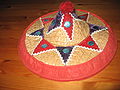 | Jaapi | A traditional hat of Assam, Bharat. There both plain and decorative japies are Available. |
 | Kalpak | A traditional lid of Republic of bulgaria, Turkey, Ukraine and Primal Asia. Fabricated primarily of lamb fur, it comes in a variety of regional styles. |
 | Karakul (Qaraqul) | A lid made from the fur of the Qaraqul breed of sheep, typically worn by men in Fundamental and South asia and popular among Soviet leaders. |
 | Kepi | A generic worldwide military hat with a apartment, circular top and visor. Commencement seen in central Europe. |
 | Kippah or Yarmulke | A close-plumbing equipment skullcap worn by religious Jews. |
 | Kolpik | Brown fur chapeau worn by Hassidic Jews. |
 | Ghutrah | Three piece ensemble consisting of a Thagiyah skull cap, Gutrah scarf, and Ogal black ring. Gutrahs are plain white or checky, cogent ethnic or national identities.[ citation needed ]. |
 | Kupiah | Traditional cap from Aceh |
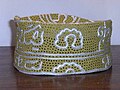 | Kofia | Brimless cylindrical cap with a flat crown, worn by men in E Africa. |
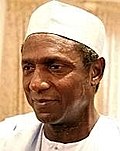 | Kufi | A brimless, brusk, rounded cap worn by Africans and people throughout the African diaspora. |
 | Kolah namadi | A felt hat , typically worn by men in the rural areas of Iran |
 | Kova tembel | Cloth hat worn by Israeli pioneers and kibbutzniks. |
| | Makapili Lid | Bamboo basket worn over the head covering the entire head with just holes for the eyes and worn by some members of the Makapili, Filipinos who were Japanese collaborators during World War 2 in the Philippines. |
 | Mathal | Distinctive hat worn by farmers in the Bangladesh and Eastern India made of bamboo with a conical summit. |
 | Mitre | Distinctive chapeau worn past bishops in the Roman Catholic Church building, Eastern Orthodox Church, and the Anglican Communion. |
 | Montera | A crocheted hat worn by bullfighters. |
 | Mortarboard | Apartment, foursquare chapeau. Usually has a button centered on top. A tassel is fastened to the push button and draped over one side. Worn as part of bookish wearing apparel. Traditionally, when worn during graduation ceremonies, the new graduates switch the tassel from 1 side to the other at the conclusion of the ceremony. |
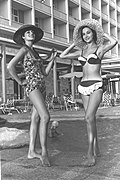 | Mushroom lid | Hat with a distinctly downwards-facing brim similar to the shape of a mushroom or toadstool. Popular from the 1870s, but particularly associated with the Edwardian era and Dior'due south "New Look". |
 | Pakul | Circular, rolled wool lid with a flat top, common in Pakistan and Transitional islamic state of afghanistan. |
 | Panama | Straw chapeau fabricated in Ecuador. |
 | Papakhi | Also known every bit astrakhan hat in English, a male wool chapeau worn throughout the Caucasus. |
 | Political party hat | A conical hat, similar to the Dunce cap, oft worn at birthday parties and New Year's Eve celebrations. It is frequently emblazoned with bright patterns or messages. |
 | Patrol cap | Also known every bit a field cap, a picket cap, or in the United States a mosh cap.; a soft cap with a stiff, rounded visor, and flat top, worn past military personnel in the field when a combat helmet is non required. |
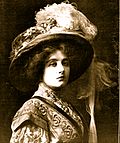 | Peach basket hat | A woman's chapeau resembling an upturned fruit basket. Ordinarily lavishly trimmed, it achieved notoriety in the early 1900s. |
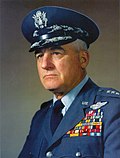 | Peaked cap | A military style cap with a flat sloping crown, band and peak (also called a visor). It is used by many militaries of the world also equally law enforcement, besides as some people in service professions who wear uniforms. |
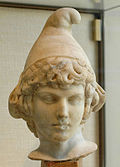 | Phrygian cap | A soft conical cap pulled forward. In sculpture, paintings and caricatures it represents freedom and the pursuit of liberty. The popular cartoon characters The Smurfs wear white Phrygian caps. |
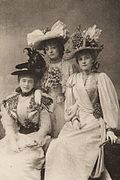 | Picture lid | Likewise known as a Gainsborough hat and garden hat, this is an elaborate women's pattern with a wide skirt. |
 | Pilgrim'south hat | A pilgrim's hat, cockel hat or traveller's lid is a broad skirt hat used to keep off the sunday. It is highly associated with pilgrims on the Way of St. James. The upturned skirt of the lid is adorned with a scallop vanquish to denote the traveller'south pilgrim condition. |
 | Pillbox hat | A minor hat with direct, upright sides, a apartment crown, and no skirt. |
 | Pith helmet | A lightweight rigid fabric-covered helmet made of cork or pith, with brims front and back. Worn by Europeans in tropical colonies in the 19th century. The pith helmet is an adaptation of the native salakot headgear of the Philippines. |
 | Planter's hat | A lightweight straw hat, with a broad brim, a circular crown and narrow round dent on the outside of the meridian of the crown. Worn by Clark Gable in Gone with the Wind, and Paul Bettany in Chief and Commander. |
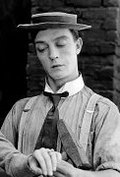 | Porkpie | Felt hat with low flat crown and narrow brim. |
 | Qeleshe | A white brimless felt cap traditionally worn past Albanians. Also known as a plis or qylaf. |
 | Rastacap | A tall, round, usually crocheted and brightly colored, cap worn by Rastafarians and others with dreadlocks to constrict their locks abroad. |
 | Rogatywka | A characteristic field cap worn by partisans in Earth War II guerrilla fights as well by the officers of Polish armies. |
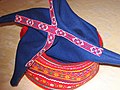 | Sami lid | Also known equally a "Four Winds" hat, traditional men'southward lid of the Sami people. |
 | Sailor cap | A round, apartment visorless chapeau worn past sailors in many of the globe'due south navies |
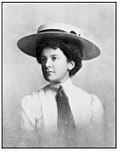 | Sailor chapeau | A flat-crowned, brimmed straw lid inspired past nineteenth century sailors' headgear. |
 | Šajkača | Serbian national and traditional lid worn by men. |
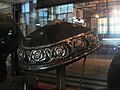 | Salakot | A traditional hat in the Philippines. |
 | Santa Hat | A floppy pointed red hat trimmed in white fur traditionally associated with Christmas. |
 | Shako | A tall cylindrical military cap, normally with a visor, badge, and plume. Usually used past higher and high-school marching bands. |
 | Shtreimel | A fur hat worn by married Hassidic men on Shabbat and holidays. |
 | Slouch | Generic term covering wide-brimmed felt-crowned hats oftentimes worn by military leaders. Less fancy versions can be chosen bush hats. |
 | Sombrero | A Mexican lid with a conical crown and a very wide, saucer-shaped brim, highly embroidered made of costly felt. |
 | Songkok | A cap widely worn in Indonesia, Negara brunei darussalam, Malaysia, Singapore, the southern Philippines and southern Thailand, mostly amid Muslim males. May be related to the taqiyah. |
 | Sou'wester | A traditional form of collapsible oilskin rain chapeau that is longer in the back than the front to protect the neck fully. A gutter front brim is sometimes featured. |
 | Stetson | Also known as a "Cowboy Lid". A high-crowned, wide-brimmed hat, with a sweatband on the inside, and a decorative hat band on the outside. Customized by creasing the crown and rolling the skirt.[7] |
 | Pupil cap | A cap worn by university students in diverse European countries. |
 | Lord's day chapeau | A hat which shades the confront and shoulders from the lord's day. |
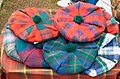 | Tam o' Shanter | A Scottish wool lid originally worn past men. |
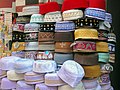 | Taqiyah | A round cloth cap worn by Muslim men. |
 | Top hat | Also known as a beaver hat, a sorcerer's hat, or, in the instance of the tallest examples, a stovepipe (or pipestove) lid. A tall, flat-crowned, cylindrical hat worn by men in the 19th and early 20th centuries, now worn only with morn dress or evening apparel. Cartoon characters Uncle Sam and Mr. Monopoly are often depicted wearing such hats. In one case made from felted beaver fur. |
 | Toque | (informally, "chef's hat") A alpine, pleated, brimless, cylindrical hat traditionally worn by chefs. |
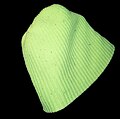 | Tuque | In Canada, a knitted lid, worn in winter, usually made from wool or acrylic. Also known every bit a woolly hat, ski cap, knit hat, knit cap, sock cap, stocking cap, or watch cap. Sometimes called a toboggan or goobalini in parts of the Usa. In New Zealand, Australia, the United States and the Uk, the term "Stocking Cap" (and more recently, the misnomer "beanie"[ citation needed ]) is applied to this cap. |
 | Trilby | A soft felt men'southward hat with a deeply indented crown and a narrow skirt oft upturned at the back. |
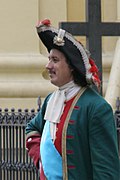 | Tricorne | A soft hat with a low crown and broad brim, pinned up on either side of the head and at the back, producing a triangular shape. Worn past Europeans in the 18th century. Larger, taller, and heavily ornamented brims were present in French republic and the Papal States. |
 | Trucker lid | Similar to a baseball cap, commonly with a foam brim and forepart section and a breathable mesh back section. |
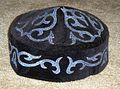 | Tubeteika | A round, slightly pointed cap with embroidered or applique patterns worn throughout Central Asia. |
 | Tudor bonnet | A soft round blackness academic cap with a potent skirt that has a cord with tasseled ends knotted effectually the base of the crown, the ends draping over the skirt. |
 | Turban | A headdress consisting of a scarf-like single piece of fabric wound effectually either the caput itself or an inner hat. |
 | Tyrolean hat | A felt hat with a corded band and feather ornament, originating from the Alps. |
 | Umbrella hat | A lid fabricated from an umbrella that straps to the head. Has been fabricated with mosquito netting. |
 | Upe | A Bougainvillean headdress made from tightly wound straw. |
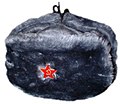 | Ushanka | A Russian fur chapeau with fold-down ear-flaps. |
 | Vueltiao | A Colombian hat of woven and sewn black and khaki dried palm braids with indigenous figures. |
 | Whoopee Cap | A skullcap made from a human being'southward felt fedora hat with the brim trimmed with a scalloped cut and turned up. |
 | Wizard/witch lid Pointed hat | A conical hat with a wide brim and a kleptomaniacal top, traditionally worn past fictional wizards or witches. |
 | Zucchetto | Skullcap worn by clerics typically in Roman Catholicism. |
0 Response to "Korean Style Pink Cap Korean Men Fashion Caps"
Post a Comment